Saturday, November 12, 2011

Parodies


I am posting parodies on the Best American Poetry Blog today -- as a finale for a week of guest blogging with Nicole Santalucia.

Friday, November 11, 2011

Bed Making Class


There is a photograph of a few girls and a teacher smoothing a bed with this caption in Wonder World, Volume VII.

Wednesday, November 9, 2011

Contagion


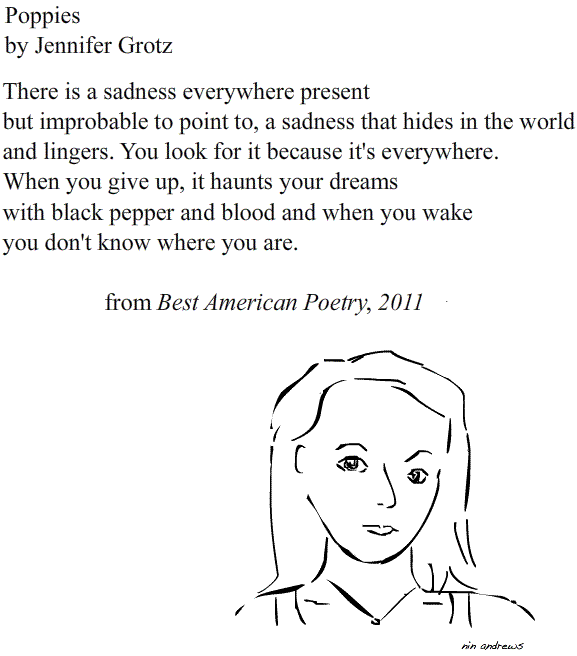
I am guest blogging on Best American Poetry's blog this week. This is one of the poems I featured there today. The poem reminds me of the film, Contagion, or what I have heard of it. I am not sure why anyone would want to watch a movie about the spread of deadly disease.

Tuesday, November 8, 2011

Writers' Fear


After posting the Juan Ramon post below, I had a few friends contact me and say they feared their manuscripts were the unloved ones . . . that they were Juan Ramon. I suppose we all fear that our manuscripts and books are unloved children, sent out into a cold and heartless world. Sigh.

Ham


When I think of ham, whether it's Green Eggs and Ham, or just any old ham, I think of how my mother paid for my eye surgeries with Christmas hams. And by letting the doctor use my eyes for his research. I was, she said, a good specimen.

Monday, November 7, 2011

Sunday, November 6, 2011

I Do Not Like It, Juan Ramon


What do you say when a dear friend and talented writer shows you his or her latest manuscript, and you aren't thrilled?

Friday, November 4, 2011

Questions about International Aid Work


This is an old photo, from El Salvador.
I am still trying to understand how aid works, how it works well and not so well, and why. I am still thinking about the article in the entry below . . .

Wednesday, November 2, 2011

Food for Peace


As many of you know, Suzanne is in Kenya, working in development. I learn a lot from her, as you might imagine.

Although it is not the major focus of her work, I often ask her about the famine. One of the major issues that confronts relief organizations is how food aid does and does not work well. There is a great article about it which Suzanne pointed out to me . . . I will quote from it and then link it below.

"America’s biggest food aid program sits in the farm bill because the program was originally designed as a way to get rid of surplus agricultural products to keep prices high. But seeing food aid through the lens of domestic agricultural means there has never been serious consideration of how to make food aid more effective."

http://opinionator.blogs.nytimes.com/2011/11/01/how-to-feed-the-hungry-faster/?ref=opinion

Remembering American History


I hated history class when I was in grade school. The history books were so boring . . .

When I was in 3rd grade, our teacher left suddenly, and we were given a substitute. Poor lady. No one did any work for her. I would draw pictures of what she called "our American heroes" instead of doing reports. I think I informed her that this was an option allowed by our REAL teacher.

I remember drawing a picture of Paul Revere. I drew a little boy and wrote underneath: Paul Revere before his midnight ride. And then I added--he didn't even own a horse yet.

My father said my Paul Revere should at least wear a hat and long hair. I wasn't sure if he had a hat yet, or a ponytail, but just in case, I drew two pictures, one with the hat and a ponytail, one without.

Years later, when I think of Paul Revere, I think mostly about that weird hat.

Richorexics Anonymous Comic, 3

Sunday, October 30, 2011

Little Englishmen


Suzanne tells me that in Sudan, they've nicknamed these tiny bananas, Little Englishmen.

(Sudan was colonized by the British.)

from Kenya


A new photo from Suzanne--taken at a celebration in Taita Taveta near the Tanzania border . . .
I love the way they seem to be jumping straight up--as if from a standing position.

Salt


from "The Old Woman's Hide," which is in Italian Folktales, Selected and Retold by Italo Calvino

I love the openings of fairy tales. Often the stories are not nearly as inspiring, but the first paragraphs . . .

Saturday, October 29, 2011

Michael Jackson: This Is It


I used to suspect that Michael Jackson was really an alien.
I love his advice to artists . . . You gotta let it simmer.

Friday, October 28, 2011

Seven Billion!


Born just in time for trick or treat . . .

I hope some of them are ETs. We sure could use some extra-planetary help with this problem, which even environmental groups avoid discussing for fear of offending some religious people. (And some economists?)

Tuesday, October 25, 2011

A Diet of Murderous Thoughts

My Last Duchess


I had to give the duchess a bit of an attitude. And a few more years . . . Somehow the desire for her to strike back overtakes me . . .

I have to read and teach at Lake Erie College today, and I am taking Tom Clark's wonderful new book, Canyonesque, with me. I plan to and use the poem, "Poetry Lesson" in class.

Sunday, October 23, 2011

Mighty Be Our Powers


This book is not as well-written as What is the What or Infidel, but it's still a fascinating history of Liberia, as well as a memoir. It was also inspiring to read about these women . . . empowering.

Saturday, October 22, 2011

The fairest of them all


In the world of poets, I always feel like the terrier in a party of lovely cats.

Boston terriers, now they are real genetic anomalies. Genetic anomaly, or genetic sport, the words my mother used to apply to me, meaning I don't know where you came from, but it wasn't me.

The term, genetic anomaly, always reminds me of those stupid questions teachers used to give us in what they called New Math, back in first grade. There would be a set of 4 things: a cow, a pig, a dog, and a fork. And you were supposed to circle what doesn't belong in the set. I always wondered who thought up those questions? What is wrong with the adults in this world?

Of course, I always wanted to make up my own sets: a pea, an acorn, a thimble, a snow flake . . . A rain drop, a sofa, a tea cup, a tower . . . A fairy, a fink, a bite, a teaspoon . .

Friday, October 21, 2011

Saturday Oct. 22 with Chris Barzak and Karen Schubert


I will be visiting Chris Barzak's class tomorrow at 11:00
and then reading and teaching with Karen Schubert at the Boardman Y at 2:00.

I love list poems. A list of lies is such a great idea for a poem, and Karen's is a great one.
I am not sure if my little excerpt does it justice. You can read the whole thing here:
http://anti-poetry.com/anti/schubertka/

Chris's story is a magical sci-fi retelling of a rust-belt city in its smokiest days--a city that consumes the lives of its inhabitants. Painterly in style, "Smoke City" takes you into an unlit world, and at the end, you come out, like the main character, blinking at the light.

Beatrice and Virgil


I am amazed at how people can suffer the most horrific experiences in wars and say it strengthens their faith, as in the case of the women in Liberia.
The reaction of the father in Atwood's The Blind Assassin makes more sense to me:

"However, a much worse thing had happened: my father was now an atheist. Over the trenches God had burst like a balloon, and there was nothing left of him but grubby little scraps of hypocrisy. Religion was just a stick to beat the soldiers with, and anyone who declared otherwise was full of pious drivel. What had been served by the gallantry of Percy and Eddie, their bravery, their hideous deaths?"

Thursday, October 20, 2011

Beatrice and Virgil


I have a habit of reading books without reading the reviews or summaries, and often I have no idea what I am getting into. As a result, I end up reading horrific tales of war and violence, themes I would normally attempt to avoid. For example, lately I recently read Murakami's Wind Up Bird Chronicles and Yan Martel's Beatrice and Virgil and Life of Pi.

In the Murakami novel a Japanese soldier is skinned alive by Mongolian and Russian soldiers. In the Martel novel, Life of Pi, Martel uses animal killings as a metaphor for human violence. A hyena eat a a zebra, slowly, ick, and, well, let's just say it's very reminiscent of the Murakami scene.

InBeatrice and Virgil I realized, only in the second half of the novel, that one of the main characters is a Nazi war criminal, seeking forgiveness. I also learned that this book was not nearly as well liked as Pi, but I really liked it. I think it has many of the appealing aspects of a Murakami novel-- it is deeply imagined and moves on many levels. In the end, the book reminded me (ever so slightly) of that movie, The Fog of War, in which Robert McNamara talks for hours about his role in World War II and Vietnam, as if he is needing to explain, to apologize, to redeem himself, even as he confesses.

Wednesday, October 19, 2011

From Kenya


http://savings-revolution.org/blog/2011/10/14/lend-money-home.html

I have had so many questions about Suzanne, I thought I would post a link to her latest entry on the savings revolution blog, as well as a photo from her field work. She is in the field again this week, so I should have new pictures soon.

The Ear Model


I been reading a lot of Murakami, and I keep thinking about certain themes, ideas, characters and images that recur in his books. Ears, for example. In his book, A Wild Sheep Chase, he has the main character fall in love with an particular ear model. It begins with a photograph and progresses to a relationship with a call girl-ear model. First he sees photos of his ears . . .

"The real reason I didn't take the photos down was that these ears had me in their thrall. They were the dream image of an ear. The quintessence of ears. Never had any enlarged part of the human body (genitals included, of course) held such strong attraction for me. They were some great whirlpool of fate sucking me in."

Monday, October 17, 2011

Sunday, October 16, 2011

from Our Wonder World, copyright 1914

Wuthering Heights Comic


. . . "it would degrade me to marry Heathcliff now; so he shall never know how much I love him; and that, not because he's handsome, Nelly, but because he's more myself than I am. Whatever our souls are made of, his and mine are the same, . . . "

Oh, swoon. Oh throb. Oh, how many semicolons can one use in a single novel?

I read this book every summer btw fifth and eighth grade. Sigh.